Research and development of phenolic molding plastics for 20 years
About Us
Research and development of phenolic molding plastics for 20 years
A useful housing trial records the material, mould, actual process conditions and inspection results. When a defect appears, record its location and the stage at which it becomes visible. Use those records to investigate the issue and compare a controlled follow-up trial.
This guide concerns phenolic compound moulded into sandwich maker outer housings. Review the PF2A4-161J product information for the grade documentation to confirm before setting up a trial.
Confirm which moulding process is supported for the supplied grade and equipment. Use the corresponding processing instructions rather than transferring settings from another material or grade.
Check the regions identified as critical in the drawing. Record incomplete filling, flash, pores, surface marks and damage during release. Measure the agreed dimensions at a defined stage after moulding, using a consistent measurement procedure.
If the mould allowance depends on shrinkage, obtain the grade-specific shrinkage basis and verify it in the trial. Define when dimensions will be checked again after the relevant heat or moisture exposure.
No single set of settings fits every part: tooling, wall thickness and part size all move the window. The reference ranges our technical team works from for our phenolic compounds are:
| Parameter | Reference range |
|---|---|
| Mould temperature (fixed half / moving half) | 165–175 °C / 170–180 °C |
| Barrel temperature (front / rear) | 90–100 °C / 70–80 °C |
| Injection pressure | 80–160 MPa |
| Clamping pressure | 100–200 MPa |
| Back pressure | 1–3 MPa |
| Hold time | 10–20 s per mm of wall thickness |
Verify the window against the drawing and the tooling in a recorded trial.
Moisture is the most common source of moulding defects in phenolic compound. A number of the blistering problems we see trace back to storage or shipping moisture rather than to the compound itself. Slightly damp material can be dried at 75–85 °C for 1.5–3 hours before moulding; sustained heat above about 90 °C starts to pre-cure the powder. Material with hard lumps or a tacky surface should be set aside. Keep stock on first-in-first-out rotation and do not blend old and new batches in the same run.
| Observed issue | Records and questions to review |
|---|---|
| Delamination | Where does separation occur, and when? Compare the batch, storage history, structure and actual process records. |
| Warpage | When do dimensions move outside the requirement? Review wall geometry, curing and release records, assembly interfaces and exposure history. |
| Cracking | Does it appear during release, assembly or heating? Review corners, wall thickness changes, fastening areas and the conditions at that stage. |
| Pores or surface pitting | Review storage exposure, filling, venting and actual pressure records against an acceptable trial. |
| Uneven colour or surface marks | Compare material preparation, mould temperature distribution, filling records and the location of the marks. |
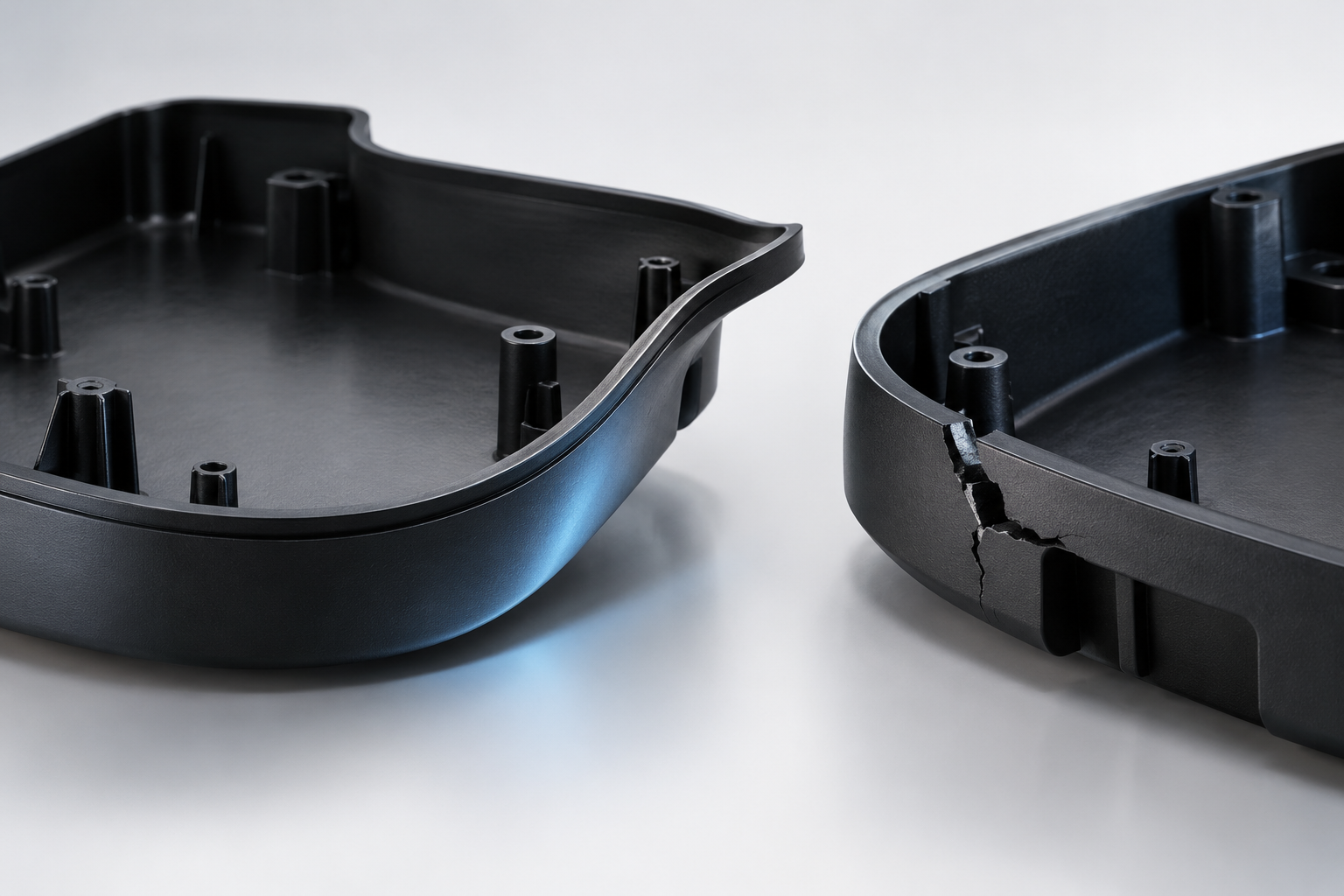
These questions organise the investigation. Confirm a suspected factor by comparing appropriate records and trial results before assigning a cause. Follow the agreed grade instructions when making process changes.
A domestic small-appliance manufacturer reported raw-material batch variation and insufficient heat resistance from its previous supplier. Its sandwich maker outer housings showed delamination and warpage, and defects remained a persistent production concern.
The manufacturer switched suppliers and used PF2A4-161J. Its application feedback described improved heat resistance and dimensional stability, followed by years of continuing batch supply. The available account is qualitative and does not assign a measured improvement percentage or isolate every contributing process factor.
For your housing, preserve the defect definition, process conditions and comparison results. This allows a supplier change or process adjustment to be evaluated against the actual problem.
State the change being investigated, the comparison conditions and the inspection criteria. Record the results using the same drawing, measurement procedure and defect definitions. Retain the material and process identities for both trials.
Once the trial meets the agreed moulding and appearance requirements, complete the relevant housing validation and supplier qualification. A satisfactory moulding trial is one part of production approval.
For a discussion of a defect, send the drawing, photographs, material batch, storage history and actual process records. If you require finished housings, include the manufacturing and inspection scope described in the sourcing guide.
Return to the sandwich maker outer-housing application guide for the full selection and procurement process.
 English
 Türkçe
 ไทย
ไทย Tiếng Việt
 العربية (الجزائر)
 العربية (مصر)
 Português
 Español (Perú)
 Español (México)
 Bahasa Melayu
 فارسی
فارسی اردو
اردو العربية (المغرب)
 Bahasa Indonesia
 বাংলা
বাংলা